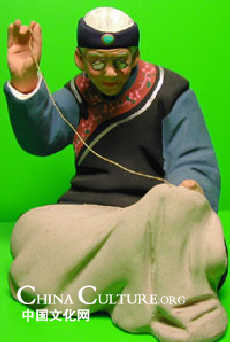
The craft of making painted clay-figurines has long been a popular folk art in China. There are different schools of clay-figurine making in terms of styles, including Fengxiang clay figurine in Shaanxi Province, Clay Figurine Zhang in Tianjin, Huishan clay figurine in Wuxi, Jiangsu Province, and Gaomi clay figurine in Shandong Province.
Hu Xinmin, the leading successor of Fengxiang figurines from Shaanxi Province, and Zhang Hongyue, the fifth generation of ‘Clay Figurines Zhang’ from Tianjin, are at the Olympic Village to demonstrate their skills on the spot.
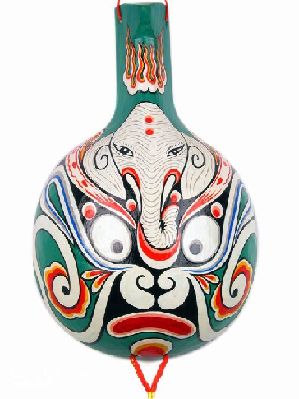
The Fengxiang figurines are made of local clay, which was mixed with pulp1 and painted after it was shaped. The colors of Fengxiang figurines are extremely bright, and with intensive contrasts. With a black outline, they are primarily scarlet2, green and yellow. The figurines have a wide-range of subjects, including facial makeup3, folklore4, historical stories, rural life and others. Their bold and short shapes are widely exaggerated.
‘Clay Figurines Zhang’ was a kind of school of art in northern China. It was initiated5 by Zhang Mingshan in the late Qing Dynasty (1644-1911). His clay figurines were very vivid and expressive6, and Zhang and his figurines were soon well known in the surrounding area. Zhang not only inherited the legacy7 of traditional skills but also incorporated skills from other art forms such as painting, opera singing and Chinese folk wood engravings. People liked his clay figurines very much and gave him the nickname of Clay Figurine Zhang.
Facial masks
Zhao Yongqi, the Lianpu (facial make-up in Peking Opera) artist from Beijing, is invited to the Olympic Village to demonstrate his face-painting skill.

 收听单词发音