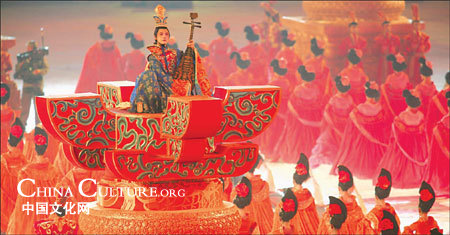
When the Duke of Zhao finished, a Qin historian on the site immediately
noted1 that the Duke of Qin "ordered" the Duke of Zhao to play music, a gesture of one-upmanship.
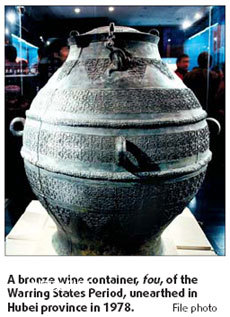
Lin Xiangru, a wise prime minister serving the Duke of Zhao, asked the Duke of Qin to play fou, which was popular in Qin. When he was refused, Lin said: "If Your Highness doesn't play, in five steps, I am willing to spray the blood of my neck onto Your Highness."
Not far away, Lian Po, a great general of Zhao, had a big army massed on the border, ready to rescue his king if necessary. Finally, the Duke of Qin struck a fou with a stick. Lin noted this: On that day, the Duke of Qin played fou "for" the Duke of Zhao.
The interesting anecdote2 shows the importance of music in Chinese history. Ancient Chinese rulers had seen music as a way of enlightening people, and to use a modern expression, creating a harmonious3 society.
Back in the Zhou Dynasty that spanned eight centuries until 256 BC, music was part of a strict ritual system that upheld the social stratum4. While the emperor enjoyed musical bells and chimed stones that lined on four sides, the dukes only had bells and stones on three sides.
The requirements were not so strict by the time of the great philosopher and educator Confucius (551-479 BC), who saw this as a sign of a collapsing5 social order. Throughout his life, Confucius avidly6 learned about ancient rituals and music, which formed a main part of his teaching.
The oldest musical instruments found in China were the bone flutes8 unearthed9 in 1987 from Jiahu, Henan province. Dating back more than 8,000 years, the flutes were drilled with five to eight holes on bones of cranes and other animals.
It is fascinating that one of the flutes had been broken into three parts before being buried next to its owner. But the pieces were linked together with thin thread, showing the great love it once enjoyed.
As the animal bones vary in length and thickness, ancient musicians made marks on the bones to find out the best places to drill holes that would produce harmonious musical notes. Today, some of the bone flutes are on display at the Capital Museum in Beijing.
Many people mix the guqin with another stringed instrument called the guzheng, which was also featured at the Opening Ceremony with a dozen players. Producing a much louder sound with happier and faster tones, this instrument usually has 25 strings10. While the guqin is an aloof11 solo instrument, only occasionally played with the se, ruan (stringed instrument) or xiao flute7, guzheng has a taste of the grassroots, with folk tunes12 forming a big part of its repertoire13.
Another instrument that generates rapid music is pipa. In the Dunhuang Mogao grottoes in Northwest China's Gansu province, one mural depicts14 a flying aspara, or Buddha's attendant, plucking the strings of a pipa behind her head while balancing herself on one foot.

 收听单词发音