
| ||||||||||||||||||||||||||||||||||||||||||||||||||||||||||||||||||||||||||||||||||||||||||||||||||||||
|
Jan. 31, 2007 When the Wright Brothers lifted off at Kitty Hawk1 in 1903, they flew a plane with two sets of wings, one below the other. Their feat2 went down in history as the first successful flight by a heavier-than-air aircraft.
New evidence suggests that dinosaurs4 may have beaten the Wright Brothers to the punch in coming up with a biplane design.
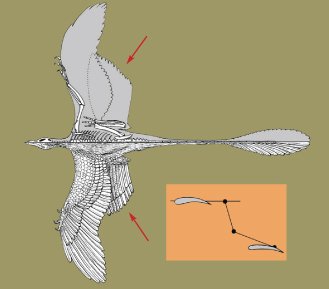
Four years ago, paleontologists described a species of dinosaur from China called Microraptor gui. These dinos were about 3 feet long and feathered. They even had feathers on their legs and feet. The leg feathers puzzled scientists. Some researchers proposed that the dinosaurs opened their legs into a split when they flew, creating a second set of wings behind the first. None of M. gui's closest relatives, however, had hips6 that were flexible enough to stretch out that far. Now, two scientists have a new theory of how these creatures glided7. Their model proposes that M. gui dangled8 its legs underneath9 its body while in the air. This would have created two sets of wings, one below and slightly behind the other. Biplanes that do aerobatic stunts10 have a similar design.
The 19-centimeter-long feathers near the bottom of the animal's legs support this theory, the scientists say. Their design would have helped keep the feathers from twisting as the dinosaur generated lift. Based on this model, the scientists say that M. gui probably could not have survived a vertical11 fall from a tall tree. However, computer flight simulations show that, if the animal took a strong horizontal leap from a branch, its biplane wings could have carried it to other trees at least 40 meters (130 feet) away. The technique would have made M. gui efficient in the air, but the dinosaurs were probably not very graceful12 on land. They did not have strong chest muscles, suggesting that they could not take off from the ground. And with such long leg feathers, the animals probably would have tripped all over themselves while walking.—E. Sohn
点击  收听单词发音 收听单词发音
|
||||||||||||||||||||||||||||||||||||||||||||||||||||||||||||||||||||||||||||||||||||||||||||||||||||||
上一篇:Odor-Chasing Penguins 下一篇:全球变暖趋势比预计糟糕2倍 |
||||||||||||||||||||||||||||||||||||||||||||||||||||||||||||||||||||||||||||||||||||||||||||||||||||||
- 发表评论
-
- 最新评论 进入详细评论页>>