
| |||||||||||||||||||||||||||||||||||||||||||||||||||||||||||||||||||||||||||||||||||||||||||||||||||
|
Jan. 9, 2008 You add like a monkey. No, really. Recent experiments with rhesus macaques suggest that monkeys do high-speed addition in much the same way as people do.
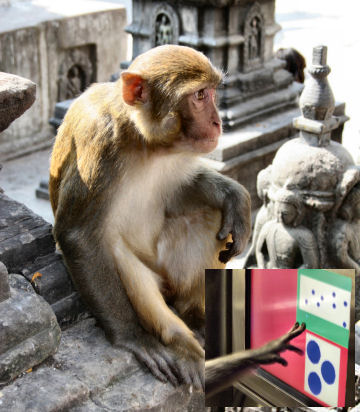
Duke University researchers Elizabeth Brannon and Jessica Cantlon tested college students' ability to add numbers as quickly as possible without counting. The researchers compared the students' performance with that of rhesus macaques taking the same test. Both the monkeys and the students typically answered in about a second. And their test scores weren't all that different.
The scientists say that their findings1 support the idea that some forms of mathematical2 thinking use an ancient skill, one that people share with their nonhuman ancestors. "These data are very good for telling us where our sophisticated3 human minds came from," says Cantlon. The research is an "important milestone," says animal-math researcher Charles Gallistel of Rutgers University in Piscataway, N.J., because it sheds4 light on how the ability to do math developed. Monkeys aren't the only nonhuman animals with math skills. Previous experiments have shown that rats, pigeons5, and other creatures also have some kinds of abilities to do rough calculations6, says Gallistel. In fact, his research suggests that pigeons can even do a form of subtraction7 Brannon says she wanted to come up with a math test that would work for both adult humans and monkeys. Previous experiments were good at testing monkeys, but they didn't work as well for people. In one such experiment, for example, Harvard University researchers put some lemons behind a screen as a monkey watched. Then, as the monkey continued to observe, they put a second group of lemons behind the screen. When the researchers lifted the screen, monkeys saw either the correct sum of the two groups of lemons or an incorrect sum. (To reveal8 incorrect sums, the researchers added lemons when the monkeys weren't looking.) When the sum was incorrect, the monkeys seemed surprised: They stared longer at the lemons, suggesting they were expecting a different answer. An experiment such as this is a good way to test toddlers' math skills, but not the most effective way to measure such skills in adults. So Brannon and Cantlon developed a computer-based addition test, which both people and monkeys (after some training) could do. First, one set of dots flashed on a computer screen for a half-second. A second set of dots appeared after a short delay. Finally the screen showed two boxed sets of dots, one representing the correct sum of the previous sets of dots and the other displaying an incorrect sum. To respond to the test, subjects, which included 2 female9 rhesus macaque monkeys and 14 college students, had to tap a box on the screen. The researchers recorded how often the monkeys and students tapped the box with the correct sum. The students were told to tap as quickly as possible, so that they wouldn't have the advantage of counting out an answer. (Students were also told not to count the dots.) In the end, the students beat the monkeys–but not by much. The humans were right about 94 percent of the time; the macaques averaged 76 percent. Both the monkeys and the students made more mistakes when the two sets of answers differed by only a few dots. The study only measured the ability to approximate10 sums, and people are still better than animals at complicated11 math problems. In other words, it probably wouldn't be a good idea to hire a monkey as a math tutor12!—Agnieszka Biskup
点击  收听单词发音 收听单词发音
|
|||||||||||||||||||||||||||||||||||||||||||||||||||||||||||||||||||||||||||||||||||||||||||||||||||
上一篇:Catfish(鲶鱼) 下一篇:Thieves of a Feather |
|||||||||||||||||||||||||||||||||||||||||||||||||||||||||||||||||||||||||||||||||||||||||||||||||||
- 发表评论
-
- 最新评论 进入详细评论页>>