黑洞的能量效率惊人,如果地球上的汽车引擎效率能像黑洞一般,则一加仑的汽油可跑十亿英哩!
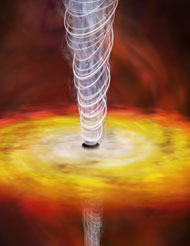
Waste not.
Surrounding matter is sucked toward a supermassive black hole, where it is expelled back out at enormous speed in an incredibly efficient process.
Credit: Harvard-Smithsonian Center for Astrophysics
|
|
High-Mileage Black Holes
By Phil Berardelli
ScienceNOW Daily News
24 April 2006
Astronomers1 have discovered that, deep inside the biggest and brightest
galaxies2 in the universe, jets are spewing particles from around black holes in an incredibly energy-efficient manner. If an
automobile3 engine worked as well as one of these monsters, it could go more than a billion miles on a gallon of gas.
The surprise is these high-mileage black holes aren't quasars, which are considered the most energetic and efficient bodies in the universe at converting matter to energy . Instead, astronomers have discovered, they are relatively4 old and quiet supermassive black holes that somehow can maintain similar efficiencies while expelling much less energy.
The astronomers used data from the Chandra X-ray Observatory5 to study nine supermassive black holes populating very large elliptical galaxies. In all cases, they found the areas around the black holes to be dim in visible light but quite bright in x-ray wavelengths6. For the nine objects studied, they calculated that the black holes could convert up to 2.5% of the infalling gas and dust to energy--not quite as good as a quasar, which can average 5% or more, but still about 25 times better than the best nuclear power reactors7.
The team also found that the jets produced by the supermassives are streaming outward at incredible speeds--in some cases 95% of the speed of light. "The energy in these jets is absolutely huge," says lead researcher Steven Allen of Stanford University in Palo Alto, California, "about a trillion, trillion, trillion watts8." The findings were announced during a media teleconference today and will be published in an upcoming issue of the Monthly Notices of the Royal Astronomical9 Society.
The question is what process converts the energy from the gas streaming in toward the black holes to the enormous energy in the jets. So far, there is only speculation10, says co-author Christopher Reynolds of the University of Maryland, College Park. One idea is that the rotational11 energy of the supermassives powers the engine.
"We already knew quasars were enormously efficient at making light," says Kimberly Weaver12, an astrophysicist at NASA's Goddard Space Flight Center in Greenbelt, Maryland. "Now we know black holes in elliptical galaxies are also as efficient at making x-rays." This also could explain why there are few young stars in these galaxies: When the jets collide with the surrounding interstellar gas, they heat it to the point where it cannot condense into new stars.
"Just as with cars, it's critical to know the fuel efficiency of black holes," Allen adds. "Without this information, we cannot figure out what is going on under the hood13, so to speak, or what the engine can do."
 收听单词发音