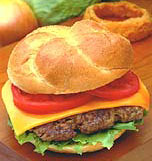
 Fast food restaurants are feeding the obesity1 epidemic2 by tricking people into eating many more calories than they mean to, an important study has shown.
Typical menus at McDonald's, KFC and Burger King contain 65 per cent more calories per bite than standard British meals, making it far too easy ffor customers to overindulge without realising it.
The high "energy density3" of junk food - the amount of calories it contains in relation to its weight - throws the brain's appetite control system into confusion, as this is based on the size of a portion rather than its energy content.
The critical role of energy density in obesity has been revealed by Andrew Prentice, Professor of International Nutrition at the London School of Hygiene4 and Tropical Medicine, and Susan Jebb, of the Medical Research Council Human Nutrition Centre in Cambridge.
In a study published in the journal Obesity Reviews, they calculated the average energy density of menus at McDonald's, KFC and Burger King, using nutritional5 data from the fast food chains' websites.
The average energy density of these restaurants' meals was 263 calories per 100 grams, 65 per cent more than the density of the average British diet and more than twice that of a recommended healthy diet. This means that a person eating a Big Mac and fries would consume almost twice as many calories as someone eating the same weight of pasta and salad.
Professor Prentice said that the human appetite encouraged people to eat a similar bulk of food, regardless of its calorific value. This left regular consumers of fast food prone6 to "accidental" obesity, in which they grew fat while eating portions they did not consider large.
Professor Prentice added: "Since the dawn of agriculture, the systems regulating human appetites have evolved for the low-energy diet still consumed in rural areas of the developing world, where obesity is almost non-existent. Our system of appetite control is completely unpicked by the junk food diet."
When fast food is eaten often, even small miscalculations of portion size can have major effects, the study found. If a person eats 200g extra of fast food with a density of 1,200kJ per 100g just twice a week, he would consume an extra 250,000kJ a year. This is enough to put on almost 8kg of fat.
Fast food outlets7 should reduce the energy density of their menus as well as their portion sizes, the scientists said.
 收听单词发音