
Nobel Prize for chemistry of life 2009年诺贝尔化学奖结果揭晓
(单词翻译:单击)
The 2009 chemistry Nobel Prize has been awarded to Venkatraman Ramakrishnan, Thomas Steitz and Ada Yonath.
2009年度诺贝尔化学奖被授予Venkatraman Ramakrishnan、Thomas Steitz和Ada Yonath。
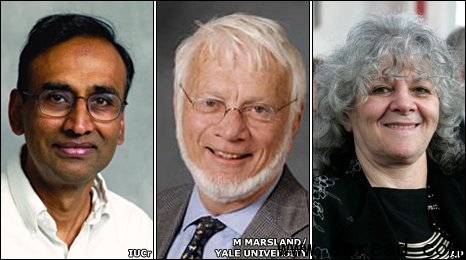
The prize will be shared equally between the three winners
The prize is awarded for the study of the structure and function of the ribosome(核糖体) - the cell's protein factory.
The ribosome translates genetic1 code into proteins - which are the building blocks of all living organisms(有机体,微生物).
It is also the main target of new antibiotics2, which combat bacterial4 strains(菌株) that have developed resistance to traditional antibiotic3 drugs.
These new drugs work by blocking the function of ribosomes in bacterial cells, preventing them from making the proteins they need to survive.
Their design has been made possible by research into the structure of the ribosome, because it has revealed key differences between bacterial and human ribosomes. Structures that are unique to bacteria can be targeted by drugs.
The announcement was made during a press conference at the Royal Swedish Academy of Sciences, during which the three winners were described as "warriors5 in the struggle of the rising tide of incurable6(不能医治的,无救的) bacterial infections".
Professor Ramakrishnan is based at the Medical Research Council's Molecular7 Biology Laboratories in Cambridge, UK.
Thomas Steitz is based at Yale University in the US, and Ada Yonath is from the Weizmann Institute in Rehovot, Israel.
The prize is to be shared equally between the three scientists, who all contributed to revealing the ribosome's huge and complex molecular structure in detail.
Professor David Garner8, president of the Royal Society of Chemistry, described the three as "great scientists" and said their work was of "enormous significance".
'Molecular machine'
These scientists and their colleagues have helped build a 3D structure of the ribosome.
In doing so, they solved an important part of the the problem posed by Francis Crick and James Watson when they discovered the twisted double helix DNA9 structure - how does this code become a living thing?
DNA is made available to the ribosome by "transcription" of genes10 into chunks11 of messenger RNA.
In the ribosome, these are read and translated into the various amino acid sequences(核基酸顺序) that make up an organism's proteins.
By looking closely at its structure, scientists are able to study how this translation process works.
The work is based on a technique called x-ray crystallography(晶体学) - where molecules12 are removed from cells, purified and made into crystals that can be examined using x-rays.
Professor Ramakrishnan told BBC News that until the ribosome's atomic structure was determined13, "we knew this was a large molecular machine that translated genetic code to make proteins, but we didn't know how it worked".
"We still don't know exactly how it works, but we have made a tremendous amount of progress as a direct result of knowing what it looks like.
"It's the difference between knowing that when you put gasoline in a car and press on a pedal(踏板), it goes. But if you know that the gasoline gets ignited(点燃,燃烧) and pushes down pistons14(活塞) and drives the wheels, that's a new level of understanding."
 收听单词发音
 |
1
genetic
|
|
| adj.遗传的,遗传学的 | |
参考例句: |
|
|
|
|
2
antibiotics
|
|
| n.(用作复数)抗生素;(用作单数)抗生物质的研究;抗生素,抗菌素( antibiotic的名词复数 ) | |
参考例句: |
|
|
|
|
3
antibiotic
|
|
| adj.抗菌的;n.抗生素 | |
参考例句: |
|
|
|
|
4
bacterial
|
|
| a.细菌的 | |
参考例句: |
|
|
|
|
5
warriors
|
|
| 武士,勇士,战士( warrior的名词复数 ) | |
参考例句: |
|
|
|
|
6
incurable
|
|
| adj.不能医治的,不能矫正的,无救的;n.不治的病人,无救的人 | |
参考例句: |
|
|
|
|
7
molecular
|
|
| adj.分子的;克分子的 | |
参考例句: |
|
|
|
|
8
garner
|
|
| v.收藏;取得 | |
参考例句: |
|
|
|
|
9
DNA
|
|
| (缩)deoxyribonucleic acid 脱氧核糖核酸 | |
参考例句: |
|
|
|
|
10
genes
|
|
| n.基因( gene的名词复数 ) | |
参考例句: |
|
|
|
|
11
chunks
|
|
| 厚厚的一块( chunk的名词复数 ); (某物)相当大的数量或部分 | |
参考例句: |
|
|
|
|
12
molecules
|
|
| 分子( molecule的名词复数 ) | |
参考例句: |
|
|
|
|
13
determined
|
|
| adj.坚定的;有决心的 | |
参考例句: |
|
|
|
|
14
pistons
|
|
| 活塞( piston的名词复数 ) | |
参考例句: |
|
|
|


