
China to raise bank reserve ratio
时间:2007-12-10 07:49:45
(单词翻译:单击)
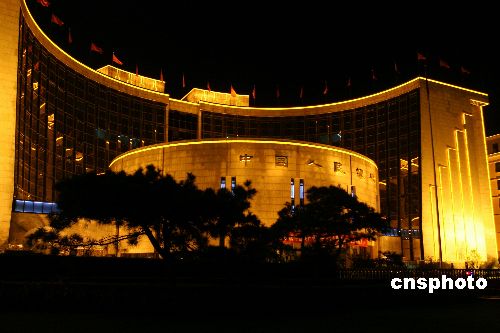
| The building of the People's Bank of China in Beijing. |
| BEIJING, Dec. 9 - China will raise the reserve requirement ratio by one percentage point for commercial banks in an effort to cool the booming economy, the central bank announced Saturday.
The move, which will take effect on Dec. 25, will push the ratio to a new high of 14.5 percent, after it reached a ten-year high of 13.5 percent on Nov. 26. This is the country's tenth rise in the reserve requirement ratio this year. It is aimed at "strengthening liquidity1 management in the banking2 system and checking excessive credit growth", the People's Bank of China said in a statement posted on its website. The move follows the government's announcement at an annual economic conference concluded on Wednesday, which said the country would shift its monetary3 policy stance from "prudent4", an approach it has followed for the last ten years, to "tightening5". It is the first time China has raised the reserve requirement ratio by as much as one percentage point since September, 2003. The other nine rises this year were half a percentage point each. It means that a tighter monetary policy has been adopted, said Song Guoqing, Professor of the Peking University. The move, launched at the end of the year, is also to prevent a boom in credit, which usually rebounds6 at the beginning of a year, he said. Concerns about investment, the prime driver of China's economic growth, has been growing this year, as urban fixed7 assets investment picked up pace by rising 26.9 percent year-on-year in the first 10 months. As the coming CPI for the first 11 months is expected to reach a new high, the move is also a reflection of the government's decision to prevent inflation, which has so far been confined to food, from spilling over into other sectors8, said Peng Xingyun, a researcher with the Research Institute of Finance under the Chinese Academy of Social Sciences. Against a background of rising trade surplus and foreign exchange reserve, the rise is a further move to hedge excess liquidity in the country, said Peng. It is estimated that a one percentage point rise of the reserve requirement ratio could reduce 400 billion yuan liquidity in the market. At a conference held by the People's Bank of China on Wednesday, the central bank plans to use various monetary policy instruments to curb9 excess liquidity and to improve the RMB exchange rate forming mechanism10 to adjust the total demand and supply and to improve trade imbalances. The central bank has raised interest rate five times this year. "China's future monetary policies will depend on the country's economic situations," said Peng, adding "It does not necessarily mean more rises in interest rates or the reserve requirement ratio."
|
点击 收听单词发音
收听单词发音 |
1
liquidity
|
|
| n.流动性,偿债能力,流动资产 | |
参考例句: |
|
|
|
|
2
banking
|
|
| n.银行业,银行学,金融业 | |
参考例句: |
|
|
|
|
3
monetary
|
|
| adj.货币的,钱的;通货的;金融的;财政的 | |
参考例句: |
|
|
|
|
4
prudent
|
|
| adj.谨慎的,有远见的,精打细算的 | |
参考例句: |
|
|
|
|
5
tightening
|
|
| 上紧,固定,紧密 | |
参考例句: |
|
|
|
|
6
rebounds
|
|
| 反弹球( rebound的名词复数 ); 回弹球; 抢断篮板球; 复兴 | |
参考例句: |
|
|
|
|
7
fixed
|
|
| adj.固定的,不变的,准备好的;(计算机)固定的 | |
参考例句: |
|
|
|
|
8
sectors
|
|
| n.部门( sector的名词复数 );领域;防御地区;扇形 | |
参考例句: |
|
|
|
|
9
curb
|
|
| n.场外证券市场,场外交易;vt.制止,抑制 | |
参考例句: |
|
|
|
|
10
mechanism
|
|
| n.机械装置;机构,结构 | |
参考例句: |
|
|
|


©2005-2010英文阅读网