
Asian elephants in China face extinction
时间:2006-09-16 07:08:34
(单词翻译:单击)
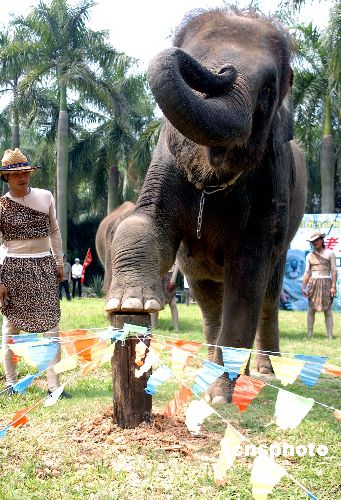
| Asian elephants are loved in all the countries for being good helper to humans where they can be found. However, their valuable tusks1 make them fall the victim of poachers, too. |
| Chinanews, Beijing, September 15 – Chinese zoologists2 have found from a recent probe that fewer than 150 wild Asian elephants currently live in China, all of which are distributed in Xishuangbannan, Lingcang and Simao in Yunnan Province. Their ivories make them major targets of poachers, and they will surely die out in the next few years, if poaching remains3 uncontrolled.
Being the biggest terrestrial animal extant, Asian elephants are tamer than they appear. They are loved in all the countries for being good helper to humans where they can be found. They are usually called "living cranes", helping4 people in heavy work like opening up wastelands, building roads, transportation, lumbering5, etc. An elephant can usually do the work of 20 to 30 people. One might not know that elephants are very good swimmers. They can keep swimming for 5 to 6 hours at the speed of 2 to 3 km per hour. No river can stop them. There is even a school for elephants in Xishuangbanna, training elephants to do a wide range of tricks on stage, which has attracted many tourists since it was founded in 1996. Nearly all the circus elephants in China are the graduates of that school.
|
点击 收听单词发音
收听单词发音 |
1
tusks
|
|
| n.(象等动物的)长牙( tusk的名词复数 );獠牙;尖形物;尖头 | |
参考例句: |
|
|
|
|
2
zoologists
|
|
| 动物学家( zoologist的名词复数 ) | |
参考例句: |
|
|
|
|
3
remains
|
|
| n.剩余物,残留物;遗体,遗迹 | |
参考例句: |
|
|
|
|
4
helping
|
|
| n.食物的一份&adj.帮助人的,辅助的 | |
参考例句: |
|
|
|
|
5
lumbering
|
|
| n.采伐林木 | |
参考例句: |
|
|
|
- 上一篇:Scientists depict the social life of humans 4,000 years ago
- 下一篇:China uses DNA to analyze 4000-year sheep fossil


©2005-2010英文阅读网