
Orangutan ruse misleads predators 猩猩妙计吓天敌
(单词翻译:单击)
Wild orangutans in Borneo hold leaves to their mouths to make their voices sound deeper than they actually are, a new study shows.
一项新研究显示,波罗洲的野生星星将树叶贴近嘴边使它们的声音听起来比平常低沉。
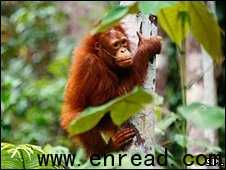
The leaf trick gives an exaggerated impression of the ape's body size
The apes employ the leaf trick when they are threatened by predators1(食肉动物), according to scientists observing them.
By holding leaves to their mouths, the orangutans(猩猩) lower the frequency of the sounds they produce.
This is used to ward2 off predators, giving them the impression the apes are a bigger target.
The international team made the discovery while observing distress3 calls made by the orangutans.
The apes make the sounds in response to approaches by snakes, clouded leopards4, tigers or humans.
These distress calls are known as "kiss squeaks5" because they involve a sharp intake6(引入口,通风口) of breath through pursed(皱起,使缩拢) lips, producing a sound similar to that made during a kiss.
But by using the leaves to modify the sound that comes out, orangutans deceive predators into thinking the calls are being made by a bigger animal.
Co-author Madeleine Hardus, from the University of Utrecht in the Netherlands, told BBC News: "This study clearly indicates that the abilities of great ape communication have been traditionally undervalued(低估,看轻) and that there may be traces of language precursors7(先驱者,前导) in our closest relatives, the great apes."
She added that the findings suggest that primate8 calling behaviour is not purely9 based on instinct(本能), but instead is socially learned.
 收听单词发音
 |
1
predators
|
|
| n.食肉动物( predator的名词复数 );奴役他人者(尤指在财务或性关系方面) | |
参考例句: |
|
|
|
|
2
ward
|
|
| n.守卫,监护,病房,行政区,由监护人或法院保护的人(尤指儿童);vt.守护,躲开 | |
参考例句: |
|
|
|
|
3
distress
|
|
| n.苦恼,痛苦,不舒适;不幸;vt.使悲痛 | |
参考例句: |
|
|
|
|
4
leopards
|
|
| n.豹( leopard的名词复数 );本性难移 | |
参考例句: |
|
|
|
|
5
squeaks
|
|
| n.短促的尖叫声,吱吱声( squeak的名词复数 )v.短促地尖叫( squeak的第三人称单数 );吱吱叫;告密;充当告密者 | |
参考例句: |
|
|
|
|
6
intake
|
|
| n.吸入,纳入;进气口,入口 | |
参考例句: |
|
|
|
|
7
precursors
|
|
| n.先驱( precursor的名词复数 );先行者;先兆;初期形式 | |
参考例句: |
|
|
|
|
8
primate
|
|
| n.灵长类(目)动物,首席主教;adj.首要的 | |
参考例句: |
|
|
|
|
9
purely
|
|
| adv.纯粹地,完全地 | |
参考例句: |
|
|
|
- 上一篇:Twitter Iran delay 'not forced' 伊朗选举,Twitter升级不受影
- 下一篇:Hackers hit Twitter and Facebook 黑客袭击Twitter和Facebook


