
Tech 'has changed foreign policy' 科技“改变外交政策”
(单词翻译:单击)
Technology means that foreign policy will never be the same again, the prime minister said at a meeting of leading thinkers in Oxford1.
英国首相在牛津大学举行的领导者会议中表示,科技意味着对外政策将永远不会一样。
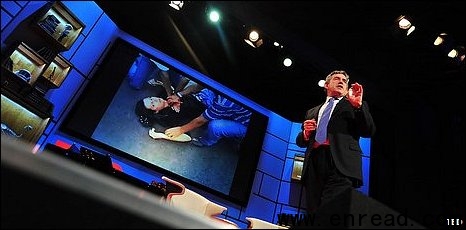
Tech's inroads to a "global society" will influence its governance, Mr Brown said
The power of technology - such as blogs - meant that the world could no longer be run by "elites2", Mr Brown said.
Policies must instead be formed by listening to the opinions of people "who are blogging and communicating with people around the world", he said.
Mr Brown's comments came during a surprise appearance at TED3 Global.
"That in my view gives us the first opportunity as a community to fundamentally change the world," he told the TED Global (Technology, Entertainment and Design) conference.
"Foreign policy can never be the same again."
Global change
The prime minister talked about the power of technology to unite the world and offer ways to solve some of its most pressing problems.
He said that issues such as climate change could not be solved alone, adding that digital technology offered a way to create a "global society".
"Massive changes in technology have allowed the possibility of people linking up around the world," he said.
In particular, he said, digital communications offered the possibility of finding common ground "with people we will never meet".
"We have the means to take collective action and take collective action together."
He talked about recent events in Iran and Burma and how the global community - using blogs and technologies such as Twitter - was able to bring events to widespread attention.
He also highlighted the role of technology in recent elections in Zimbabwe.
"Because people were able to take mobile phone photographs of what was happening at polling stations, it was impossible for [Robert Mugabe] to fix that election in the way that he wanted to do."
But Mr Brown also stressed the need to create new organisations to tackle environmental, financial, development and security problems.
"We are the first generation to be able to do this," he told the conference. "We shouldn't lose the chance."
He said that older institutions founded after the Second World War, such as the United Nations or the International Monetary4 Fund, were now "out of date".
"You can't deal with environmental problems through the existing institutions," he told the conference.
 收听单词发音
 |
1
Oxford
|
|
| n.牛津(英国城市) | |
参考例句: |
|
|
|
|
2
elites
|
|
| 精华( elite的名词复数 ); 精锐; 上层集团; (统称)掌权人物 | |
参考例句: |
|
|
|
|
3
ted
|
|
| vt.翻晒,撒,撒开 | |
参考例句: |
|
|
|
|
4
monetary
|
|
| adj.货币的,钱的;通货的;金融的;财政的 | |
参考例句: |
|
|
|
- 上一篇:La Roux leading Mercury shortlist La Roux领头Mercury奖候选人
- 下一篇:'Most' O2 web services restored “大多数”O2网络服务恢复正常


