
Honeybee mobs overpower hornets 蜜蜂发疯打败大黄蜂
(单词翻译:单击)
Honeybee hordes1 use two weapons - heat and carbon dioxide - to kill their natural enemies, giant hornets.
蜜蜂部落使用两种武器-热量和二氧化碳-杀死了它们的天敌,大黄蜂。
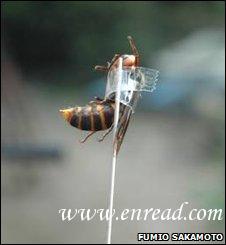
Giant hornets were taped to temperature and gas probes
Japanese honeybees form "bee balls" - mobbing and smothering2(令人窒息的) the predators3(食肉动物).
This has previously4 been referred to as "heat-balling", but a study has now shown that carbon dioxide also plays a role in its lethal5(致命的) effectiveness.
In the journal Naturwissenschaften, the scientists describe how hornets are killed within 10 minutes when they are trapped inside a ball of bees.
Japanese giant hornets, which can be up to 5cm long, are voracious6(狼吞虎咽的,贪婪的) predators that can devastate7(毁坏) bees' nests and consume their larvae8(幼虫).
But, if the bees spot their attacker in time, they mount a powerful defence in the form of a bee ball. This study found that the heat inside the bee ball alone was not enough to reliably(可靠地,确实地) kill the hornets.
"They can survive for 10 minutes at a temperature up to 47C, and the temperature inside the bee balls does not rise higher than 46C," said Fumio Sakamoto, a researcher from Kyoto Gakuen University in Japan, and one of the authors of the study.
His team recreated experimental bee balls and took direct measurements from inside them.
They anaesthetised(使…麻醉) giant hornets and fixed9 them to the tip either of a thermometer probe, or the inlet(插入物) of a gas detector10.
Once the hornets recovered from their anaesthesia, the probes were touched to the bees' nest.
"The bee ball formed (around the hornet) immediately," said Dr Sakamoto.
After 10 minutes the bees were packed solidly enough around the probe to be removed from the nest in a distinct ball.
As the temperature inside the ball increased to more than 45C, the carbon dioxide level also rose sharply.
In a parallel experiment, the scientists found that in an atmosphere relatively11 high in carbon dioxide, the temperature at which hornets could survive for 10 minutes was lowered.
"So we concluded that carbon dioxide produced inside the bee ball by the honeybees is a major factor, together with temperature, involved in the bees' defence."
Dr Sakamoto is not sure, at this point, whether the bees were effectively "gassing" the hornets, or simply depriving them of oxygen.
"Either way, the carbon dioxide increase and/or the oxygen decrease lowered the temperature that was lethal(致命的) to the hornets, " he told BBC News.
"We are going to do the additional experiments about this point using mixed air of various oxygen and carbon dioxide (concentrations)."
The mob of bees also appeared to operate in "two phases".
"The hornet may be killed during the first 0-5 minute period, in which the highest level of heat production and carbon dioxide emissions12 take place," said Dr Sakamoto.
This might suggest that the bees are aware of what physiological13 state the hornet is in.
Dr Sakamoto said: "The latter 5-10 min period may be free running to ensure their victim's death."
 收听单词发音
 |
1
hordes
|
|
| n.移动着的一大群( horde的名词复数 );部落 | |
参考例句: |
|
|
|
|
2
smothering
|
|
| (使)窒息, (使)透不过气( smother的现在分词 ); 覆盖; 忍住; 抑制 | |
参考例句: |
|
|
|
|
3
predators
|
|
| n.食肉动物( predator的名词复数 );奴役他人者(尤指在财务或性关系方面) | |
参考例句: |
|
|
|
|
4
previously
|
|
| adv.以前,先前(地) | |
参考例句: |
|
|
|
|
5
lethal
|
|
| adj.致死的;毁灭性的 | |
参考例句: |
|
|
|
|
6
voracious
|
|
| adj.狼吞虎咽的,贪婪的 | |
参考例句: |
|
|
|
|
7
devastate
|
|
| v.使荒芜,破坏,压倒 | |
参考例句: |
|
|
|
|
8
larvae
|
|
| n.幼虫 | |
参考例句: |
|
|
|
|
9
fixed
|
|
| adj.固定的,不变的,准备好的;(计算机)固定的 | |
参考例句: |
|
|
|
|
10
detector
|
|
| n.发觉者,探测器 | |
参考例句: |
|
|
|
|
11
relatively
|
|
| adv.比较...地,相对地 | |
参考例句: |
|
|
|
|
12
emissions
|
|
| 排放物( emission的名词复数 ); 散发物(尤指气体) | |
参考例句: |
|
|
|
|
13
physiological
|
|
| adj.生理学的,生理学上的 | |
参考例句: |
|
|
|


