
China Story at the Olympic Village 2
(单词翻译:单击)
Wood block printing was invented in the Song Dynasty (960-1279) and made the production of New Year's Wood Block Paintings much easier. As this art form developed and became more and more popular among Chinese people, its content and functions also increased.
Woodprint New Year painting from Wuqiang is noted1 as one of China's seven major New Year painting genres2. The other six are from Taohuawu of Jiangsu, Yangliuqing of Tianjin, Mianzhu of Sichuan, Yangjiabu of Shandong, Zhuxianzhen of Henan and Foshan of Guangdong.
Liu Guosheng and Kang Yingqin, two folk artists from the Museum of New Year’s Painting in Wuqian County, Hebei Province, are at the Olympic Village to show how to make traditional Chinese New Year’s Painting on the spot.
Paper-cuts
 |
|
|
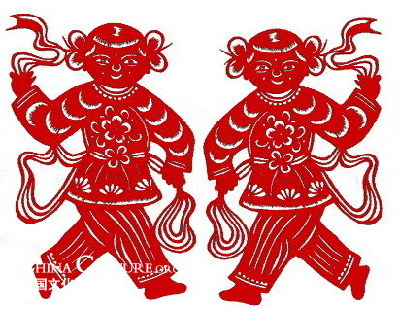
Paper-cuts refer to handicrafts made by cutting paper with scissors to form different patterns and pasting them on walls, windows, doors and ceilings. With their long history, paper-cuts, which originated in China, have been very popular among the ordinary people of China.
Chinese paper-cuts are rich in content. The auspicious3 designs symbolize4 good luck and the avoidance of evil. The child, lotus and bottle gourd5 designs suggest a family with a large number of children and grandchildren. Domestic birds, livestock6, fruit, fish and worms are also familiar objects depicted7 by Chinese farmers. There are some special paper-cuts of traditional design used as patterns for embroidering8 clothes, shoes, hats, pillows, bed curtains and door curtains.
Sun Erlin, the paper-cut artist from the Inner Mongolian Autonomous9 Region, and Liao Yunwu, the paper-cut artist from Fujian Province, were invited to the Olympic Village to display the live show of paper cutting. Born into a family of paper-cuts artists, Sun Erlin inherits her family’s cutting style and her works are tinted10 with the nomadic11 culture in the grassland12. Liao Yunwu is known for cutting paper portraits at a high speed and cutting paper with his eyes blinded.
 收听单词发音
 |
1
noted
|
|
| adj.著名的,知名的 | |
参考例句: |
|
|
|
|
2
genres
|
|
| (文学、艺术等的)类型,体裁,风格( genre的名词复数 ) | |
参考例句: |
|
|
|
|
3
auspicious
|
|
| adj.吉利的;幸运的,吉兆的 | |
参考例句: |
|
|
|
|
4
symbolize
|
|
| vt.作为...的象征,用符号代表 | |
参考例句: |
|
|
|
|
5
gourd
|
|
| n.葫芦 | |
参考例句: |
|
|
|
|
6
livestock
|
|
| n.家畜,牲畜 | |
参考例句: |
|
|
|
|
7
depicted
|
|
| 描绘,描画( depict的过去式和过去分词 ); 描述 | |
参考例句: |
|
|
|
|
8
embroidering
|
|
| v.(在织物上)绣花( embroider的现在分词 );刺绣;对…加以渲染(或修饰);给…添枝加叶 | |
参考例句: |
|
|
|
|
9
autonomous
|
|
| adj.自治的;独立的 | |
参考例句: |
|
|
|
|
10
tinted
|
|
| adj. 带色彩的 动词tint的过去式和过去分词 | |
参考例句: |
|
|
|
|
11
nomadic
|
|
| adj.流浪的;游牧的 | |
参考例句: |
|
|
|
|
12
grassland
|
|
| n.牧场,草地,草原 | |
参考例句: |
|
|
|


