
Instrumental in Spreading the Word 1
(单词翻译:单击)
|
|
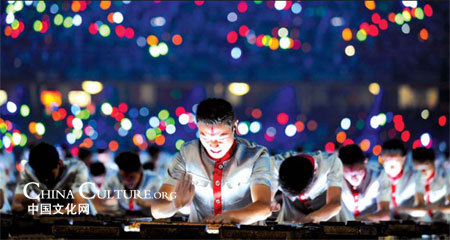
The Olympic Opening Ceremony was a unique opportunity to introduce Chinese culture to the rest of the world. Furthermore, a vital element of the ceremony was its music, which featured many traditional Chinese instruments.
Chen Leiji, 41, was one of many musicians at the ceremony but he attracted greater attention because of the instrument he played immediately after the flag-raising ceremony. Guqin, a seven-stringed zither-like instrument, has been regarded as the epitome1 of Chinese music, philosophy and culture for 3,000 years.
Born into a musician's family in Shanghai, Chen began learning guqin at age 9 and studied with master Gong Yi at the Shanghai Conservatory2 of Music before leaving for France in 1989 to study piano, composition and conducting.
His four-year trip to Europe not only provided him extensive experience with dozens of orchestras but also deepened his understanding of the Chinese music tradition.
"After learning Western music, which is very strict, I came to love the freedom of guqin," says Chen.
While the score in guqin music records the position and gesture of the hands, the rhythm is not dictated3. As a result, says Chen, "each player can have his or her own understanding of the same piece".
Symbolism runs deep in guqin music reflecting its supreme4 ability to put man in touch with nature. Its strings5, for instance, symbolize6 gold, wood, water, fire and earth - five basic elements of the universe. Emperors Wenwang and Wuwang, who founded the Zhou Dynasty in the 11th century BC, added two more strings to the instrument, which signifies the grave nature of this instrument.
Ancient Chinese scholars regarded playing guqin with a few friends in the pine forest or bamboo grove7 as one of life's greatest pursuits. It was also popular for the guqin player to chant or sing poems.
At the Opening Ceremony, Chen played guqin with many other instruments for specially-written musical scores. These other instruments carry equally profound meanings in Chinese culture.
One of them was fou, a pottery8 wine container that can be struck with a stick to produce a musical sound. The Book of History written by Sima Qian (145-c.90 BC), said that when the Dukes of Qin and Zhao met in Mianchi (in today's Henan province) in 279 BC, the Duke of Qin pretended to be drunk and asked his counterpart to play se (a stringed instrument).
 收听单词发音
 |
1
epitome
|
|
| n.典型,梗概 | |
参考例句: |
|
|
|
|
2
conservatory
|
|
| n.温室,音乐学院;adj.保存性的,有保存力的 | |
参考例句: |
|
|
|
|
3
dictated
|
|
| v.大声讲或读( dictate的过去式和过去分词 );口授;支配;摆布 | |
参考例句: |
|
|
|
|
4
supreme
|
|
| adj.极度的,最重要的;至高的,最高的 | |
参考例句: |
|
|
|
|
5
strings
|
|
| n.弦 | |
参考例句: |
|
|
|
|
6
symbolize
|
|
| vt.作为...的象征,用符号代表 | |
参考例句: |
|
|
|
|
7
grove
|
|
| n.林子,小树林,园林 | |
参考例句: |
|
|
|
|
8
pottery
|
|
| n.陶器,陶器场 | |
参考例句: |
|
|
|


